
Framework • Digital Inclusion • Systems Thinking
The Adewole Seven Pillars Framework
A systems model for understanding what future-proofed digital communities require
beyond devices, connectivity, and basic digital skills.
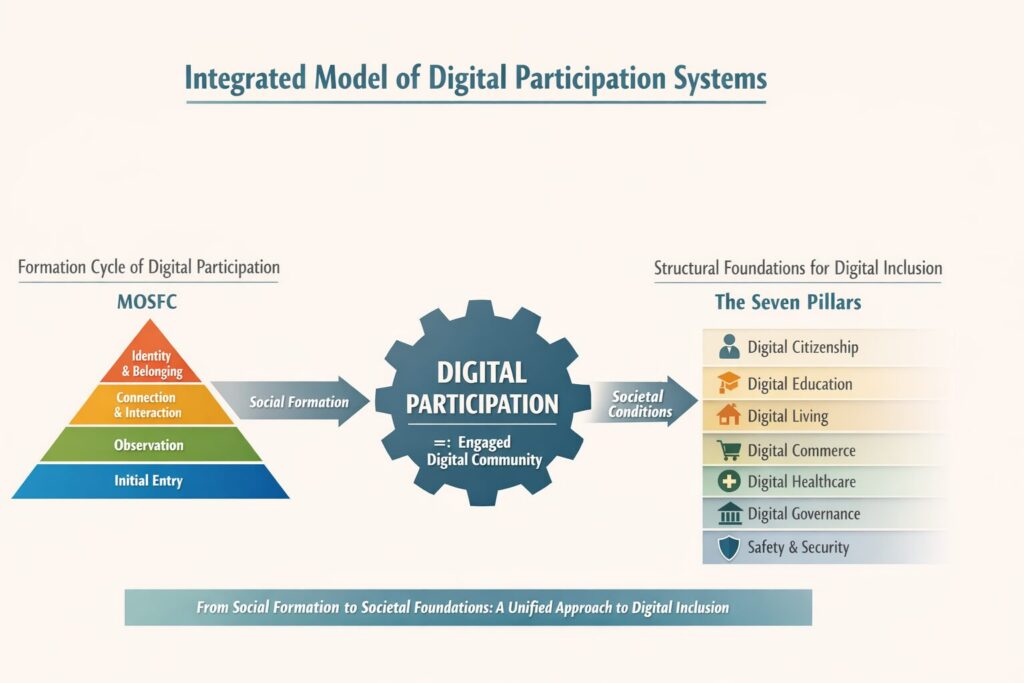
The Adewole Seven Pillars Framework identifies seven interdependent conditions required to sustain digitally inclusive societies.
This framework is intended to support policy thinking, community delivery, programme design, and research collaboration in digital inclusion and digital participation.
It emerges from practical work across community digital inclusion, research, digital participation strategy, and public-interest technology engagement.
Why a broader framework is needed
Digital inclusion is often framed narrowly as a matter of access to devices, internet connectivity, and basic digital skills. These remain important foundations, but they no longer fully explain how people participate in digital society.
In practice, digital participation is shaped by a wider ecosystem of social, institutional, and behavioural conditions. People may have access to technology and still remain excluded if confidence is low, trust is weak, governance is poor, safety is uncertain, or systems are not designed around real lives.
The Adewole Seven Pillars Framework approaches digital inclusion not as a narrow technical challenge, but as a societal participation system. It identifies seven interconnected conditions required to sustain digitally inclusive, resilient, and future-ready communities.
Origins of the framework
The framework emerged through a combination of community delivery, research, practical experimentation, and observation across digital participation initiatives.
It has been shaped by work spanning digital inclusion programmes, community partnerships, digital skills support, public-interest technology, and policy engagement. This includes practical experience across local delivery environments, contributions to wider inclusion discussions, and reflections on how digital systems are actually experienced by communities.
In this sense, the Seven Pillars should not be understood as a speculative list of ideas. It is better understood as a field-informed framework for making sense of what digitally inclusive societies require in practice.
Framework Diagram
The Seven Pillars Explained
Digital citizenship refers to the ability of individuals to participate responsibly, confidently, and ethically in digital environments.
- Online rights and responsibilities
- Respectful participation in digital spaces
- Critical awareness of digital behaviour
- Civic and social participation online
Digital education supports the knowledge, confidence, and learning pathways needed to navigate digital systems and adapt to technological change.
- Foundational digital skills
- Critical thinking in digital contexts
- Understanding emerging technologies
- Lifelong digital learning
Digital living reflects the integration of digital systems into everyday life, including communication, daily services, information access, and participation.
- Everyday communication and access
- Routine use of digital systems
- Confidence in navigating daily digital life
- Practical participation in modern society
Digital commerce addresses the economic dimension of digital participation, including entrepreneurship, online trade, and access to digital opportunity.
- Online enterprise and entrepreneurship
- Participation in digital marketplaces
- Economic opportunity through technology
- Confidence in digital transactions
Digital healthcare concerns the ability to access, understand, and benefit from digital health services and information systems.
- Access to digital health services
- Confidence using digital patient systems
- Understanding health information online
- Equitable access to digital healthcare
Digital governance focuses on how institutions design, manage, and regulate digital systems in ways that are transparent, accountable, and inclusive.
- Transparent digital services
- Institutional accountability
- Inclusive public digital infrastructure
- Trustworthy system design
Safety and security underpin trust in digital environments and protect individuals from harms that undermine participation.
- Cybersecurity awareness
- Online safety and protection
- Protection from fraud and misinformation
- Confidence and trust in participation
Why the pillars matter together
The strength of the framework lies not only in each pillar individually, but in their interaction. Weakness in one area often undermines the others.
A person may have a device and internet connection, but still remain excluded if they lack confidence, cannot access digital healthcare, do not trust systems, or feel unsafe online. Likewise, digital education alone is insufficient if governance is weak or economic participation remains inaccessible.
The Seven Pillars therefore offer a systems architecture for digital participation. They invite policymakers, practitioners, and researchers to think beyond isolated interventions and towards more complete digital ecosystems.
Implications for policy and practice
- Move beyond access-only models of digital inclusion
- Design place-based and community-aware interventions
- Integrate digital inclusion into health, governance, education, and economic systems
- Strengthen trust, dignity, and safety in digital participation
- Use delivery-level insight to shape policy design
How the framework can be used
- Policy development and strategy
- Community programme design
- Digital inclusion assessment
- Workshop and training design
- Research and collaboration
Conclusion
The Adewole Seven Pillars Framework is best understood as a practical and conceptual model for thinking about digitally inclusive societies. It argues that digital inclusion is not merely a question of technical access, but a broader question of how participation is made possible, supported, trusted, and sustained.
As digital systems become more deeply embedded in everyday life, communities will need more than devices and connectivity alone. They will need the social, institutional, and civic conditions that allow participation to be meaningful, safe, and durable.
The Seven Pillars provide one structure for understanding those conditions.
Citation
Researchers, practitioners, and organisations referencing this framework may cite it as:
The Adewole Seven Pillars Framework: A Systems Model for Future-Proofed Digital Communities.
Available at: johnadewole.com
Accessed: [insert date]